
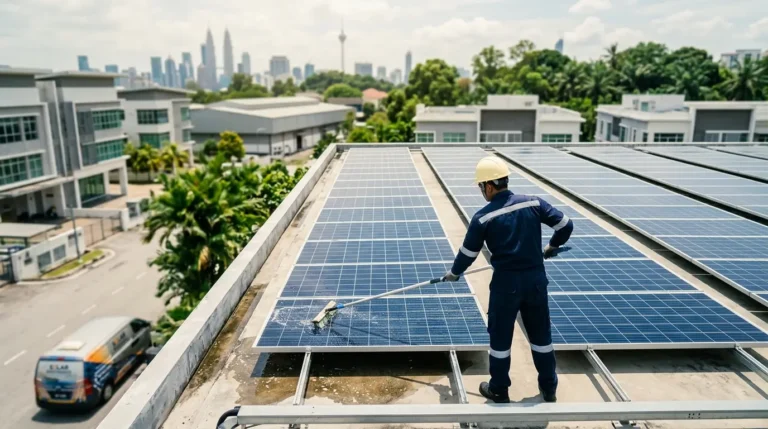
Understanding the Lifecycle Costs of Solar Panel Cleaning for Malaysian Businesses
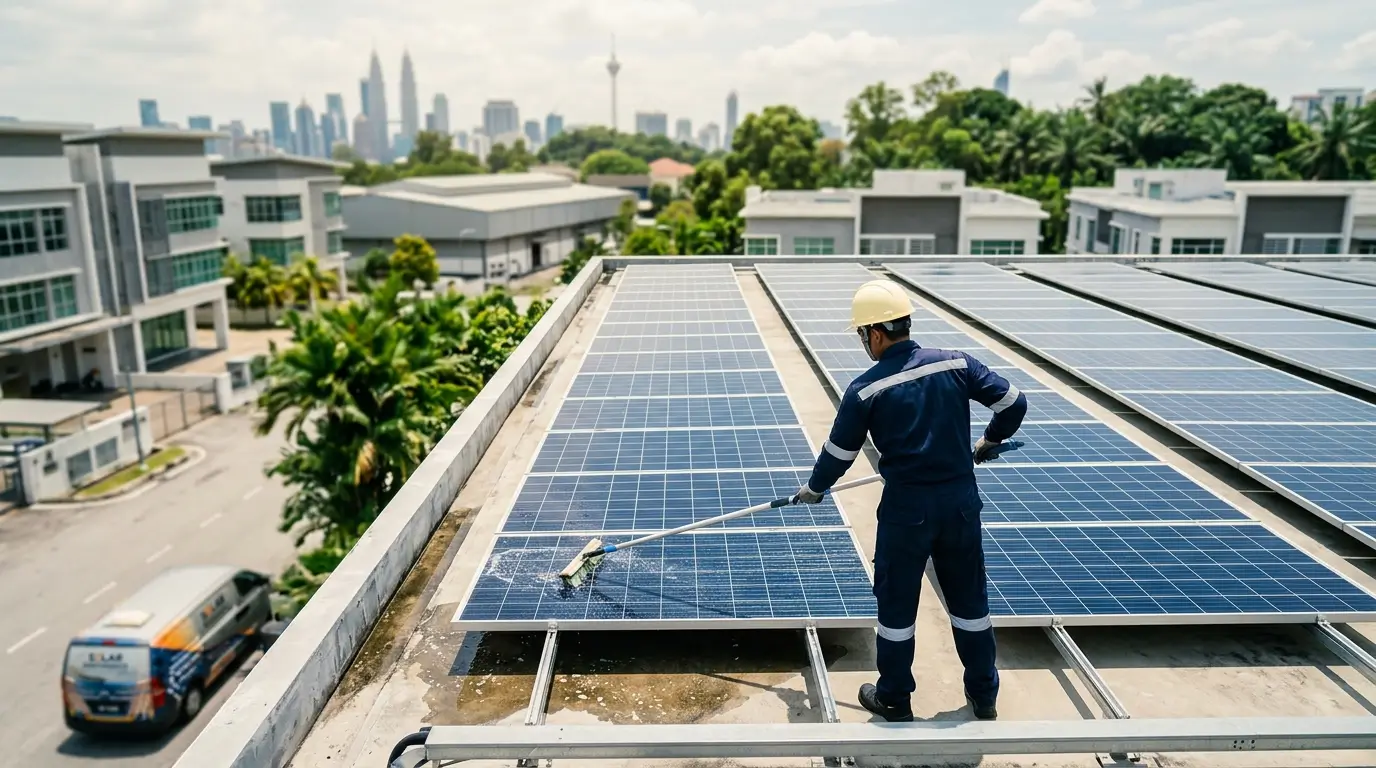
Managing Long-Term Solar Maintenance
For many property owners, the initial installation is only the first step in the journey toward energy independence. While solar PV systems are known for being relatively low-maintenance, ignoring the lifecycle costs of solar panel cleaning can lead to significant energy yield losses over time. As a 100% Bumiputera-owned company, we prioritize transparency in helping you maintain your asset, which is why we emphasize the importance of professional care in our essential guide to professional maintenance.
Environmental factors in Malaysia, such as heavy rain, dust, bird droppings, and industrial pollutants, can accumulate on your panels, reducing their light absorption. When you evaluate the total cost of ownership for your solar array, it is essential to look beyond the hardware and consider the operational expenditure required to keep your panels functioning at peak efficiency.
Why Professional Cleaning Matters
Many businesses overlook the fact that standard rainwater is rarely enough to remove stubborn grime or hardened debris. If you neglect the lifecycle costs of solar panel cleaning, your system may experience a drop in output, often ranging from 5% to 20% depending on the location and surrounding industrial activity. This loss directly translates into a lower return on investment, making professional cleaning a strategic financial decision rather than just an operational expense.
Determining Your Cleaning Frequency
The frequency at which you should clean your panels depends on your property type and location. A commercial facility located near high-traffic roads or industrial zones will naturally collect more particulate matter than a residential home in a quiet, green suburb. We recommend a baseline inspection twice a year, though more frequent cleaning may be required for specific environments. For those concerned about installation quality and durability, our comprehensive approach to solar EPCC Malaysia ensures that your system is designed for ease of access during these vital service intervals.
| Environment Type | Typical Soiling Risk | Recommended Cleaning Frequency |
|---|---|---|
| Residential (Suburban) | Low (Dust, bird droppings) | Once or twice annually |
| Commercial (City Center) | Moderate (Pollution, exhaust) | Quarterly |
| Industrial (Near manufacturing) | High (Grease, soot, heavy dust) | Every 2-3 months |
Financial Implications and ROI
When calculating the return on your solar investment, you must account for the lifecycle costs of solar panel cleaning alongside your periodic inspections. Investing in a professional provider prevents irreversible damage to the glass or anti-reflective coatings that can occur if inexperienced cleaners use abrasive tools or harsh chemicals. Proper maintenance is a core pillar of our service, as detailed in our guide on choosing the right solar company, ensuring that your hardware remains compliant with performance warranties.
If you have recently moved your energy strategy into the new government-backed schemes, maintaining your panels is even more critical. While you enjoy the benefits of the Solar ATAP programme, remember that consistent performance directly influences the credits you receive. Since the programme allows for credits to offset charges within the same billing period, a clean system ensures you maximize those credits every month.
Protecting Your Solar Investment
Ultimately, the lifecycle costs of solar panel cleaning are outweighed by the long-term energy savings you generate. By proactively budgeting for professional maintenance, you safeguard your system against performance degradation and ensure your equipment reaches its full design life of up to 25 years or more. Integrating these maintenance requirements into your initial feasibility planning, as discussed in our guide on solar feasibility studies, is the smartest way to ensure your property remains a high-performing energy producer.
Explore More
- See our full range of EPCC, feasibility study, ATAP and maintenance services
- Browse our completed solar projects
- Request a free consultation
Frequently Asked Questions
Can I clean my solar panels by myself to save costs?
While DIY cleaning is possible, it is often discouraged due to safety risks and the potential to scratch the anti-reflective glass. Professional cleaners use deionized water and soft, specialized equipment that ensures the integrity of the panels.
Does rain wash away all dirt from solar panels?
Rain can wash away loose dust, but it often leaves behind sticky residue, bird droppings, or industrial soot that can block sunlight. These require manual cleaning to restore optimal efficiency.
How do these maintenance costs affect my Solar ATAP credits?
Your Solar ATAP credits are based on the energy exported to the grid. If your panels are dirty, they produce less energy, meaning fewer credits are generated. Regular cleaning helps you maximize the financial benefits of your system.
Is it mandatory to use professional cleaning services for warranty validity?
Most solar panel manufacturers include terms in their warranty stating that damage caused by improper cleaning will void the warranty. Using a professional, SEDA-registered provider is the safest way to maintain warranty compliance.
What is the most common sign that my panels need cleaning?
A noticeable, gradual decline in your daily energy production (as monitored via your inverter app) that cannot be explained by weather patterns is a key indicator that your panels likely need cleaning.
Share on Social Media
More From IPS Insights
Ready to Go Solar ?
Our engineers will help you find the best solution for your needs.
Ready to switch to smarter energy?
Speak to our engineers. We’ll review your site and help you understand the most suitable solar solution for your needs.